AOM™
The open model for agent-ready websites.
Agent Object Model™ (AOM) — tell agents what your site can do, and what it can't, without touching your HTML.
Structured tasks, entities, actions, and policies in JSON so AI agents interact safely.
Automation posture
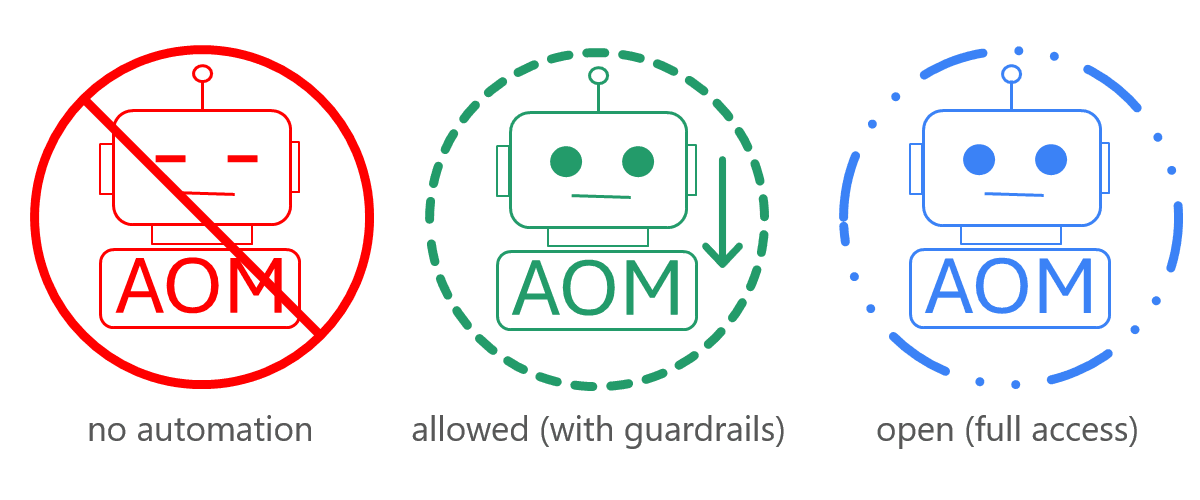
At a glance: how automation is allowed on your surface
Featured story

How to design websites for AI agents (not just humans)
Make your site agent‑ready with AOM policies: task‑centric surfaces, structured data, and clear rules that let AI agents work safely and reliably on your existing web UI.
This article is our canonical on‑site guide to designing for AI agents. If you prefer the full origin story and a more narrative walkthrough, you can also read the launch story on Medium: How to design websites for AI agents (not just humans).
Why AOM
Agents already use your site. If they only get HTML, they scrape—and every redesign can break automation. AOM™ adds a small JSON layer next to your pages so intent and policy are explicit.
- HTML-first: agents guess intent from layout—fragile when design or copy changes.
- AOM: structured surfaces + automation policy you publish and version.
- Less scraping theater—more contracts, validation, and guardrails you control.
AOM in the wild
The first sites publishing structured surfaces and automation policy.
agentobjectmodel.com
This site
AOM OpenBrand hub — surfaces: homepage, blog, use-cases, for-builders, for-businesses
aom.tools
Developer tools
AOM OpenValidator, downloads, docs, Surface Explorer extension
Know a site that's AOM-compliant? Contact us
Ecosystem
The .com site is the brand hub. Specs, schemas, and tools live in their dedicated domains — linked, not duplicated.
Spec & schemas
Normative definitions, examples, and validators.
Tools & plugins
Downloads, extensions, and docs for builders.
Blog & stories
Adoption narratives, KYA notes, and implementation guides.