Why AOM
A deeper look at the problem (scraping and guesswork), the pattern (structured surfaces + policy), and what you gain when agents read a contract—not just a layout.
Agents already use your website—as a data source for answers, actions, and integrations. If they only get human-oriented HTML, they have to scrape and guess. Agent Object Model™ (AOM) adds a small, open layer of JSON next to your pages so intent and policy are explicit, not inferred from layout.
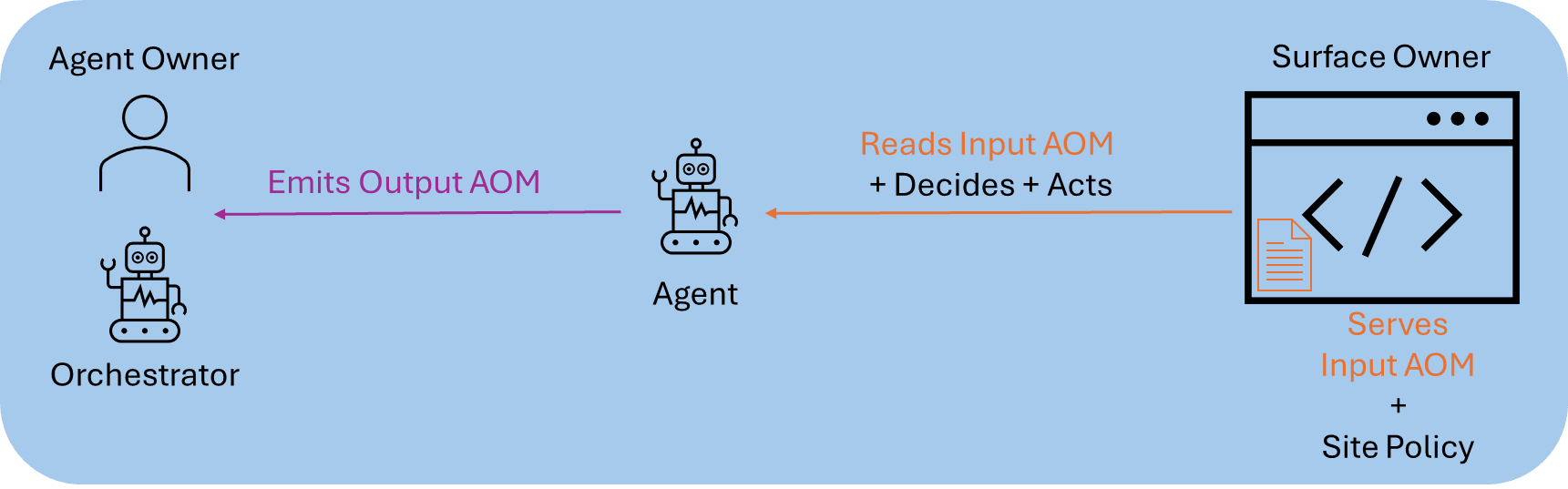
Humans read design: hierarchy, wording, buttons. Software agents do not experience the page that way. They parse markup and patterns—which change when you ship a redesign, run an experiment, or translate copy. Every shift becomes someone else’s broken automation.
AOM describes the same real world in machine-readable form: what’s on the page (entities), what can happen (tasks and actions), and what automation is allowed (policy tied to your site). Your brand and UX stay yours; the contract is versioned separately, like an API your agents can rely on.
That surface can be validated against shared schemas—so agents act inside guardrails you publish, not inside whatever a model hallucinated from the DOM. Less mystery, less fragility, and a clearer line between “allowed” and “out of bounds.”
From problem → solution
- Problem:HTML-only sites force agents to reverse-engineer intent from layout—brittle, slow, and risky every time the UI moves.
- Solution:Publish versioned AOM JSON plus an automation policy (e.g. at /.well-known/) so agents read structure and rules you control.
- Outcome:Faster, safer workflows: validation, CI, and explicit policy instead of endless selector patches.
- In short:Structured intent + explicit policy = automation that survives your next release—and stays aligned with your rules.
Traditional automation still looks at rendered HTML and guesses intent. That fails when components move, tests ship, or localization changes copy. AOM gives you a stable contract—tasks, actions, typed entities, and policies—hosted and versioned openly next to your human-facing site.